
@iau-wgsn.bsky.social
BlueSky - our IAU edu infos
Please Contact Us
Channel
@iau-wgsn.bsky.social
BlueSky - our IAU edu infos
Please Contact Us
Channel
Based on Galileo Galilei’s thought experiments (Discorsi) and alleged experiments on the Leaning Tower of Pisa, we determined the acceleration of gravity g. I suggested three possibilities to the students, and they came up with a fourth idea themselves.
Here is a sketch:
Possibility 1)
Drop a bar of chocolate with a standard weight of 100 g from the height of your own body, on average 1.70 m, and measure the time it takes to fall. The acceleration is calculated using the distance-time law s = g/2 t² + vt + a, i.e. for initial acceleration a = 0 and initial velocity v=0:
g = 2 s/t²
The result of an experiment with a person with s = 1.99 m is approximately g = 10 m/s².
Possibility 2)
The Earth has a moon with an orbital period of approximately 30 days. From the law of gravity, we get g = G * M/ r², and Kepler’s third law tells us that T²/ r³ = constant, so r = ( T²/ constant )1/3, i.e.
g = G * M * constant1/3
T2/3
The constant comes from Newton’s law of gravity, which eliminates the mass of the Earth M.
Option 3)
Experiments with a test specimen on an inclined plane that is tilted at varying angles. The students carried out this experiment. The air cushion track (friction-free) was tilted by 10, 30, 60 and 90° and the time taken for a car to travel along the track was measured each time when it was simply released at the top.
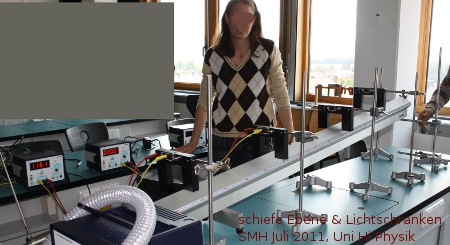
Determination of gravitational acceleration according to Galileo (Discorsi)

© 2025All Rights Reserved, Safari WordPress Theme